I was fifteen years old when I had my first course in musical history; that is, the school catalog of courses called it musical history. What this subject became in the hands of my teacher, I will tell in just a minute. This course was to be given in the small school auditorium and it was a curious and slightly awed crowd of students that filed into the hall. The stage was bare except for the piano and a small table with a heavy red cover and an ordinary chair. The chair was indispensable, but not to sit in. We had heard much about our professor; she was known to be exacting and unusual. Of her piercing questions, we had heard various details and she appeared in our minds as a very forbidding person.
In the bustle of finding our seats, getting out notebooks and pencils, we forgot to look on the stage. Suddenly a hush descended through us; looking up, we all rose and we saw Her. She had entered unnoticed, a student carrying her heavy leather briefcase. I never saw her without this huge satchel; it was always full and the boys in the class took turns getting it from her car and bringing it in. Today, it was a young Turk and she was talking to him. “Have them copied and bring them to me tonight”, in a quiet but firm tone, admitting no failure to do so. Suddenly she was aware of us still standing. “Oh, excuse me! Sit down, my children. Please!”
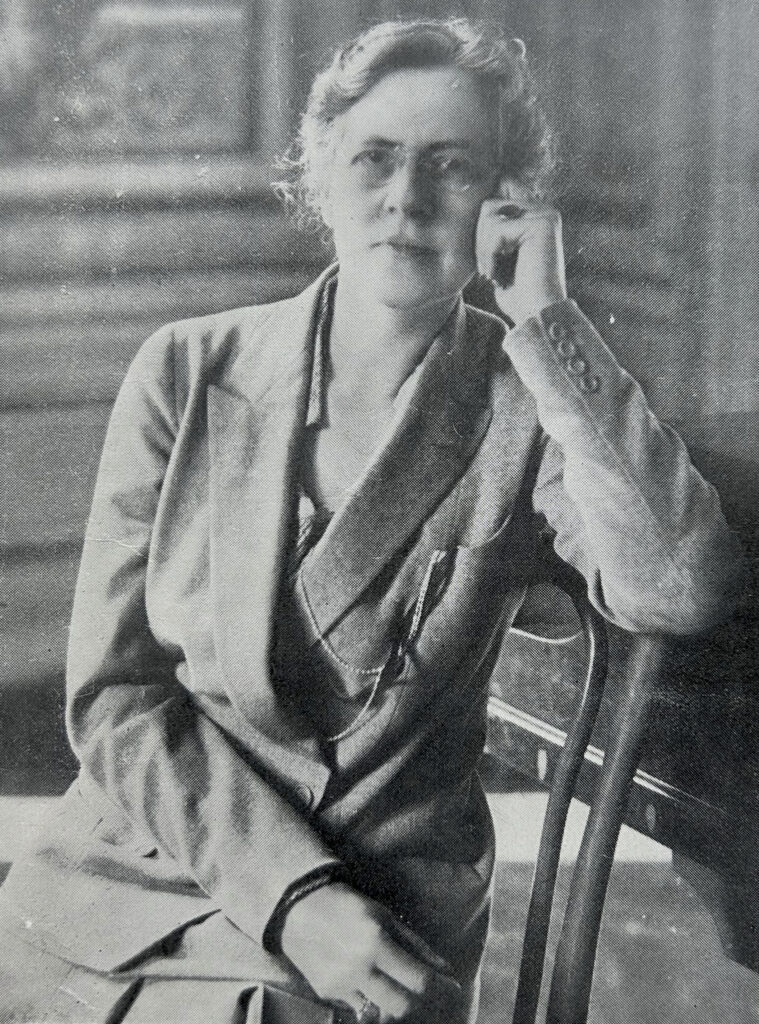
She was dressed in a black tailored suit. I never saw her in anything else except twice, and then she was in a black evening dress with long sleeves and only a moderate amount of neck showing. Her skirt had pockets, however not the usual kind that one finds on women’s skirts. These ran up and down like pockets on a man’s trousers, and were very seldom free of her hands. Black silk stockings and low-heeled black shoes completed her dress, that of a sensibly and careful woman. She always used to tell us that nothing revolted her so much as the waste of time spent in eating and dressing. “When you think that each night you take off your clothes, only to put them on again the next morning, that you wash and yet have to start over again the next day, that it is necessary to eat, how hampered we are by this train of daily habits without which we can’t get along. And yet it must be done, for we must be well dressed and clean.”
She had a large broad brimmed hat fastened to her head with a huge black hat pin. When she took it off and laid it on the piano, we could see her fine gray hair pulled back from her face in soft waves and pinned neatly in a small chignon at the nape of her neck. Her fine even features, her lovely dark eyes, which were smiling so reassuring at us now, seemed to belie her reputation for being so hard. But then she found her pince-nez glasses and started to take things out of her case: music, printed manuscripts, and books, a big pile of them. Was she going to use all of these today?
Finally she turned to us. With her hands in the pockets of her skirt, and her knee on the chair, she began to talk to us. I say “talk” intentionally for it was no prearranged speech that she recited. She had her music, she had us, and she put the two together in her own inimitable manner, her sole purpose being that we too should come to love that music as she did.
I remember very little of that first talk, except that it did not seem to have very much to do with music., I sat completely immersed in the musicality of her voice: low-pitched and with singing quality, it carried me along, evoking hundreds of thoughts but never giving me time to formulate them to myself. At one time she spoke of Pascal, quoting him. Then, opening one of her books, she read to us a paragraph of Nietzsche. And, finally, going to the piano, she played the Adagio of Beethoven’s ninth symphony, an aria from one of Bach’s cantatas, and other pieces of which I did not know the name. Turning to us, she asked, “What is the connection between these pieces?” We were startled into a complete silence. We had to answer her, but who had the courage to speak up? What did she mean, what were we supposed to say? As if she had read our minds, she smiled and began to talk.
“You don’t know what to say, you are used to a teacher who reads you a lecture; you take notes, go home and do the homework, come back, sit through another lecture, and so on. Once every so often there is an examination and then you empty your mind, giving back all the facts you want out of any number of history books. You don’t need me for that. I am here to help you develop your own thoughts, not to fill your mind with mine. Don’t be afraid of saying what you think; it may be that you will still say something trivial or stupid, better that than nothing. How can I help you if you do not talk?”
This was her whole attitude during the five years I studied with her; no matter what the subject was her manner never changed. We had to think for ourselves or she would have nothing to do with us. No syllabus could have been planned for her courses, for, although there was a very definite method and we progressed constantly, there was no timing possible. At each class, she would take up where she left off the previous time and if your work had not been satisfactory, she would go back and cover anew the ground of a previous class.
From other teachers and from books, I learned the necessary background of facts and dates. I had to in self defense, for she knew it all and took it for granted that we did. It was necessary, just as dressing and eating, but then she forgot it or only used it to go farther. From her, I learned to think, to see what there was in life outside of the material every day acts. The inspiration I derived from her presence and teaching stimulated me to the highest extent and it was always after a class with her that I did my best work. She would arouse in me the utmost curiosity about literature and art as well as music. She was determined to draw us out of our staid and established lives and carry us up the heights where she dwelt. It was her personality; she was so alive and interested in what she was doing and so earnest in her attempts to make us understand.