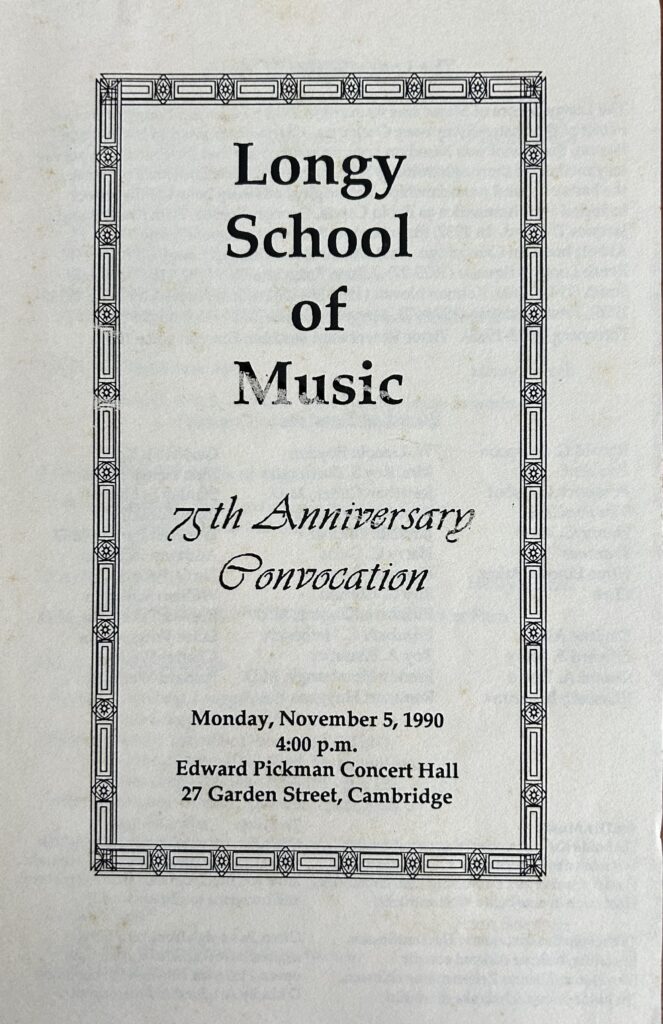
(for the 75th Anniversary Convocation, November 5, 1990)
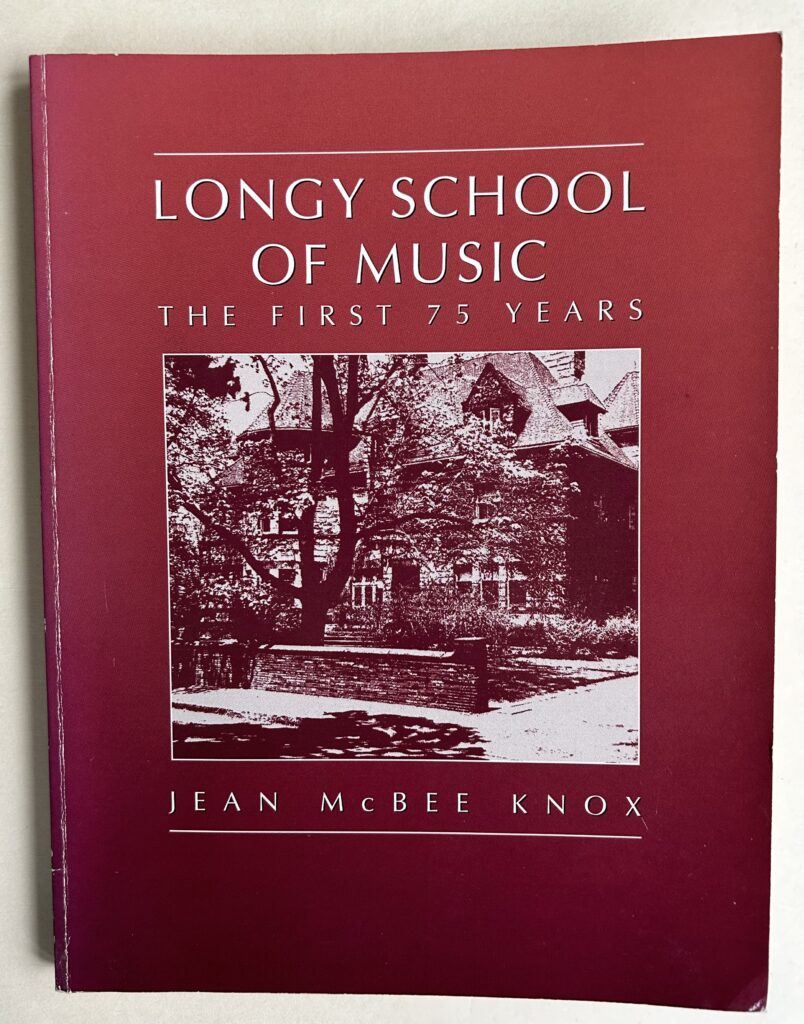
With the approaching commemoration of Longy’s 75th anniversary, my thoughts go back to the beginning of my long association with the school. It is a different place now- larger, much busier, and certainly much better known by the musical public of the Boston area. But some things have not changed. Despite the additions to the building, the character of the fine mansion remains the same as I remember it, the warmth and friendliness of someone’s home rather than that of an institution. And I like to think that the character of faculty, students, and administrators continues to be that of a large community with similar interests: the enjoyment of music and the pursuit of excellence in performance.
It was in 1941 that, newly arrived from war-torn France, I talked with Melville Smith at Longy for the first time. Attracted to the school on learning that Nadia Boulanger, with whom I had studied in Paris, was at Longy, I was eager to see it. However, another year passed (I was now married and living in Lynn) before I started to teach piano and solfège on Saturday mornings, in the children’s department.
Longy was an exciting place to this young, fresh-out-of-school person. Teaching piano to children who were also in solfège classes, where they were learning to be “literate” in the reading and singing of music, was familiar to me from my own schooling. What was new, and enjoyable, was the constant communication between the various teachers, making for much individual assessment of each student. Under the guidance of Helen Sanderson, the four-year certificate program of instrumental and solfège studies was challenging and rewarding to both students and teachers.
Besides the stimulation of my teaching, a vivid memory from that time is of the Saturday morning assemblies, when teaching would stop for a full half hour, and we all gathered in Room 2 and in the front hall- students, faculty, and parents. There were student or short faculty performances, ending with group singing of folk songs led by Melville at the piano. I still remember one great favorite, “The Raggle-Taggle Gypsies Ho!” As the student body increased over the years, the informality of these Saturdays was no longer possible, but the School always continued to stress student performance at all levels.
At a later time, with a very active Junior (high school) department, there were the thrice-yearly concerts by this age group. One of my great pleasures was playing accompaniments for these young people. Time spent working with them was most rewarding. Jerry Grossman, Phoebe Carrfai, and the very special Judith Davidoff are some that come quickly to mind. Also, there were the young singers from our program with the Cambridge Public Schools who were studying with Emily Romney. Among others in our junior classes were Anton Kurt and Robert Freeman. These and so many more went on to busy lives as well-grounded musicians.
I think back to the early years and scenes come to mind of the many concerts given in our make-shift concert hall, i.e. the front lobby, with audience spreading into Room 2 (now the Wolfinsohn Room) and up the stairs. Melville Smith was in the vanguard of early music performance on the harpsichord, aided and abetted by the enthusiastic and voluble Erwin Bodky. The latter gave a series of concerts , playing all of the two volumes of the Well-Tempered Klavier. Many preludes and fugues he played on his old harpsichord,, but others, he said, needed the clavichord, equally ancient. (Fortunately the hall was small enough for us to hear this!) Another memory of this versatile musician was of the day he came to Longy at lunch time with an early LP set of records and the score to “Les Noces.” A group quickly gathered and listened, enthralled, to this marvelous work of Stravinsky.
The Stradivarius Quartet, whose members Wolfe Wolfinsohn and Ivan d’Archambeau were on our faculty, was our “Quartet in Residence.” The annual concert series would include a concert by the quartet. Also Wolfie and d’Archambeau often played on programs with Mel Smith (harpsichord), Boris Goldovsky, and other members of the faculty. There was a Longy string orchestra at one time, and a concert by Edward Curtis comes to mind, with the players seated in the curve of the great staircase. And another, when Eunice Alberts sang a Bach Cantata with the orchestra. The building rang with music! Most members of the faculty (which was smaller in those days) took part in the concert series at the school, including E. Powers Biggs, who would give an organ recital in one of the nearby churches. For some years the last concert in the spring would be “Longy Night at Pops.”
These were heady times for me as a young performer anxious to prove my worth. I played a great deal of chamber music which I loved. I also have a very clear memory of my first full recital, with the piano in the curve of the staircase and the audience all around me! All went well, but afterwards my husband told me that I had managed to cut my time on the last movement of Franck’s “Prelude, Aria, and Finale” by more than two minutes! I shudder to think at what tempo I must have taken this piece.
The building and the dedication of the concert hall was another memorable moment in the history of the school. For the opening ceremonies, Roger Voisin climbed up to the balcony and started the proceedings with a breath-taking fanfare, followed by a program which was chosen to show off the very fine acoustics of the hall, especially for chamber music. I have always loved playing there, because of the special sound and the relaxed atmosphere.
Although now retired for some years, it is always a pleasure to return to this place that was my home away from home for many years, and to sense the continued vitality and enthusiasm of the participants in their great musical adventures.
As the 75th anniversary of Longy approaches, I reflect on my long association with the school. I recall the character of the building, the sense of community among faculty and students, and the emphasis on music enjoyment and excellence. Memories include teaching piano and solfège, Saturday morning assemblies, concerts, performances by the Stradivarius Quartet, and the dedication of the concert hall. I want to express my continued pleasure in returning to Longy and witnessing the vitality and enthusiasm of the participants.
[Margaret Rohde taught chamber music, theory, and piano at Longy. She also served as Acting Director of the School in 1977-78. the Margaret Rohde Award for Excellence in Solfege and Theoretical Studies is given in her honor each June.]