(loosely translated from a college French class essay)
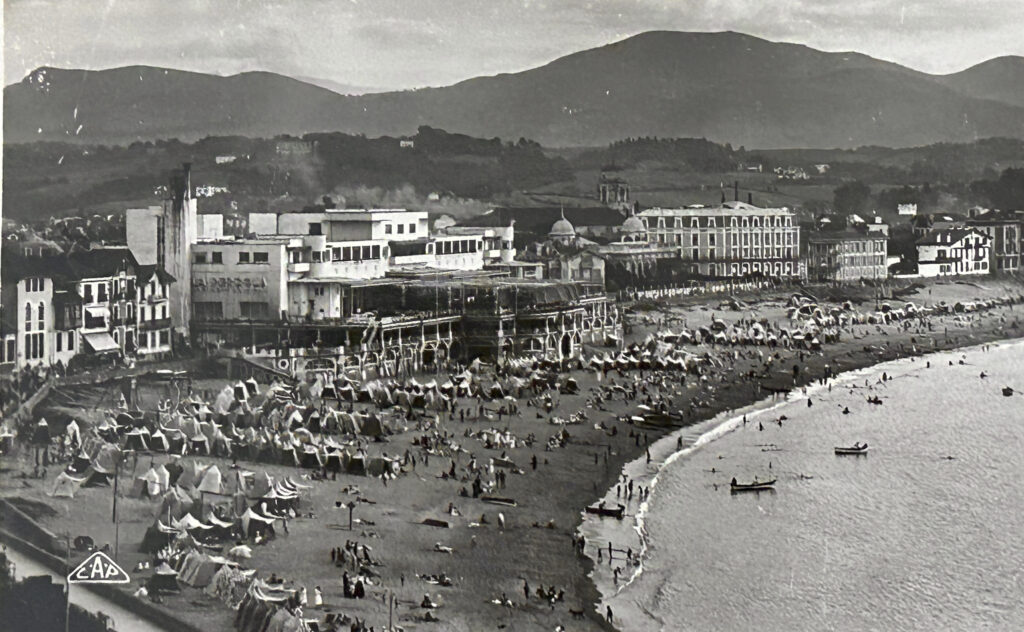
While I was at St. Jean de Luz, one of the most beautiful walks that I could take was along the length of the promenade at the edge of the ocean. The bay of this town is in the form of a semicircle, like a crescent moon, in which one of the tips, slightly elevated is ornamented by a pretty little park. It was here that I liked to go.
I remember an evening at the end of a splendid day when I made this short excursion. Arriving at my observation post, I saw spread out before me a magnificent scene. To the left was an immense ocean with an enormous ball of fire, the setting sun, shining through some clouds colored red and orange. The sky, very clear, reflected its clear blue on the almost calm sea, having only light ripples.
At my feet was the bay, in front the little village of Ciboure. Some small boats with sails of all colors were leaving from port for night fishing. At the base of the bay, I saw St. Jean de Luz, with its colored houses, the light of the setting sun tinting them with rose. From the center of the beach rose the casino, a large white building with a flag floating on top. Behind and seeming to rise from the bay there was “La Rhune”, “Les Trois Couronnes”, and other peaks of the Pyrenees. Proud of their eternal tranquillity, they were standing there, changing colors every instant; red, orange, purple, and finally to a soft and vague blue gray. Finally, they seemed to recline in the distance and mix with the sky.
The scene that I have described was very familiar to the inhabitants of Saint Jean de Luz. But there was a difference this evening. It was the flag that flapped softly above the casino: a red flag with an enormous black symbol: the swastika cross. And on the terrace, there was music from the German regiment starting their first concert. It was July 4th, 1940, and the Germans had been there for four days, having traversed all of France to arrive in this little corner so distant.
No matter! The scene is always still magnificent.