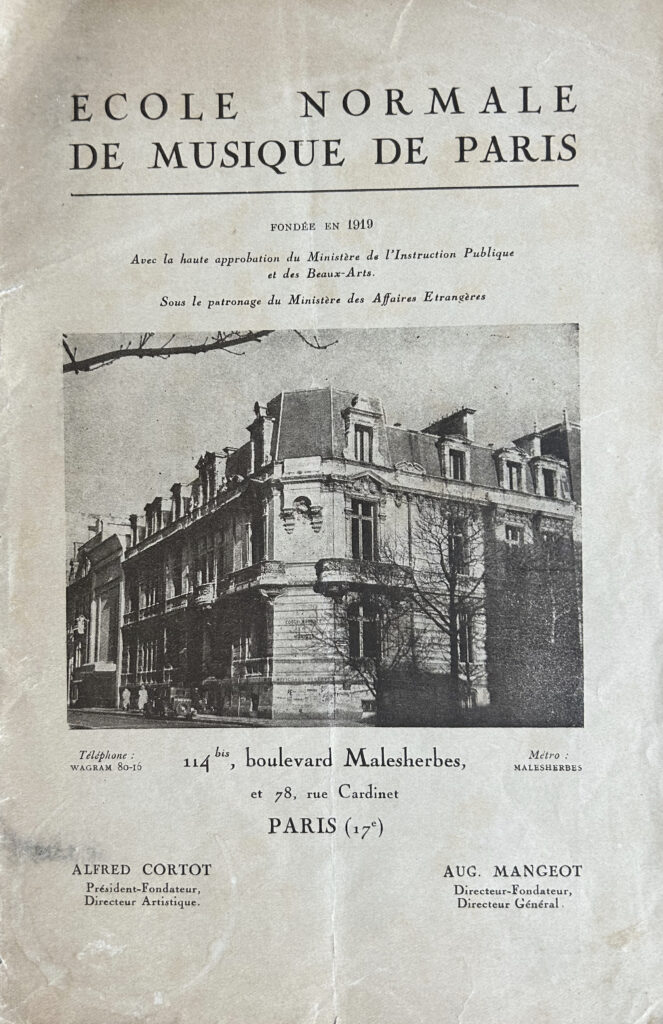
One of the interesting things I found among Mom’s memorabilia was a 1930’s brochure from the École Normale, with a brief history of the school, an outline of the the school’s programs, and some old photographs. The exterior has not changed since then, and when Mom visited in 1968, the interior had not changed much either. (Unfortunately, when I was there, the school was closed for summer vacation!) It must have been very nostalgic for Mom to walk around in the halls and classrooms she had known so well. I remember her talking about people she met there, and I would like to think she ran into someone she had known from when she was a student, perhaps a teacher, although I can’t remember exactly what she told me. (Did she see Nadia Boulanger on that trip or am I imagining that? Perhaps not; Nadia would have been in her 80’s then.)
The school was founded in 1919 by French pianist Alfred Cortôt and Auguste Mangeot. In 1927, the school moved to the Belle Epoche mansion at 114 Boulevard Malesherbes, where it still exists. In 1929, an Art Deco style concert hall (now Salle Cortôt) with seating for 500 was added to the building. By the 1930’s, the school brochure mentioned 60 teachers and around 700 students from 30 different nationalities, although the majority were French. The term école normale (normal school) meant a teacher training institution, and the school intended to produce well-trained music teachers as well as concert performers.
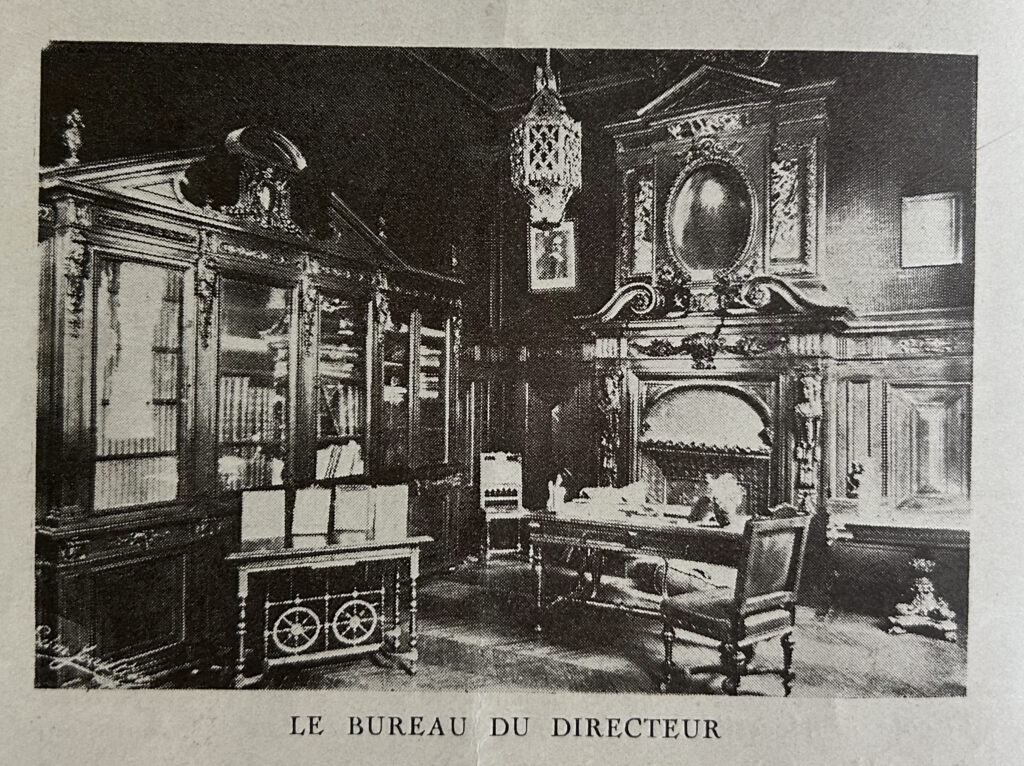
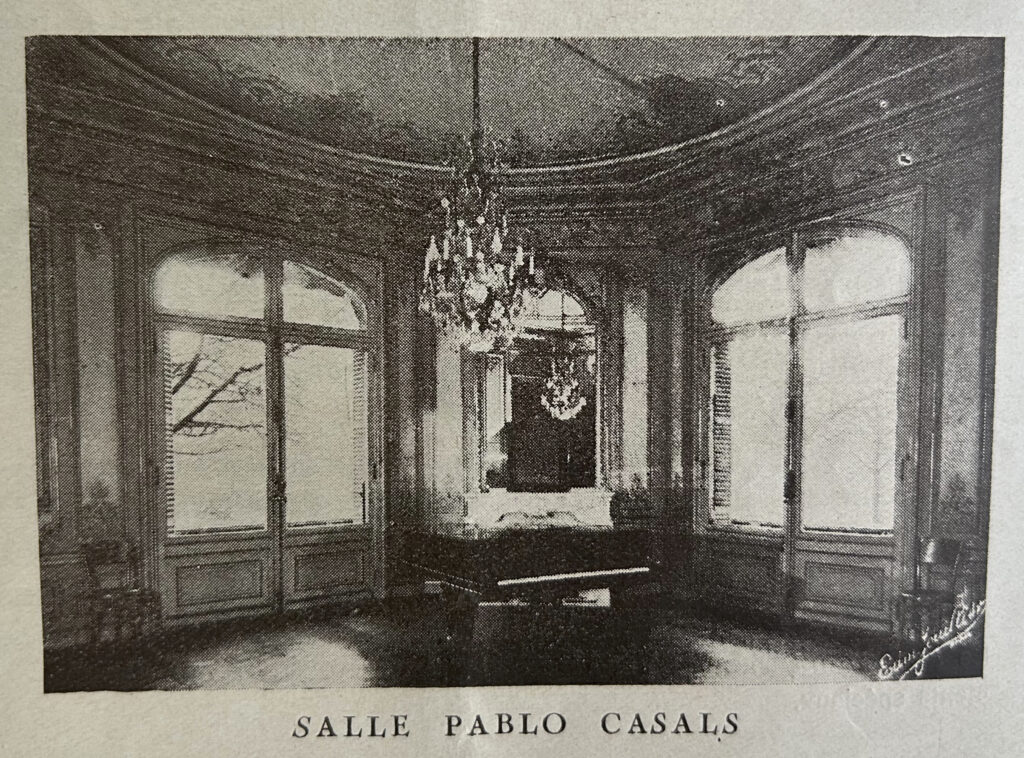
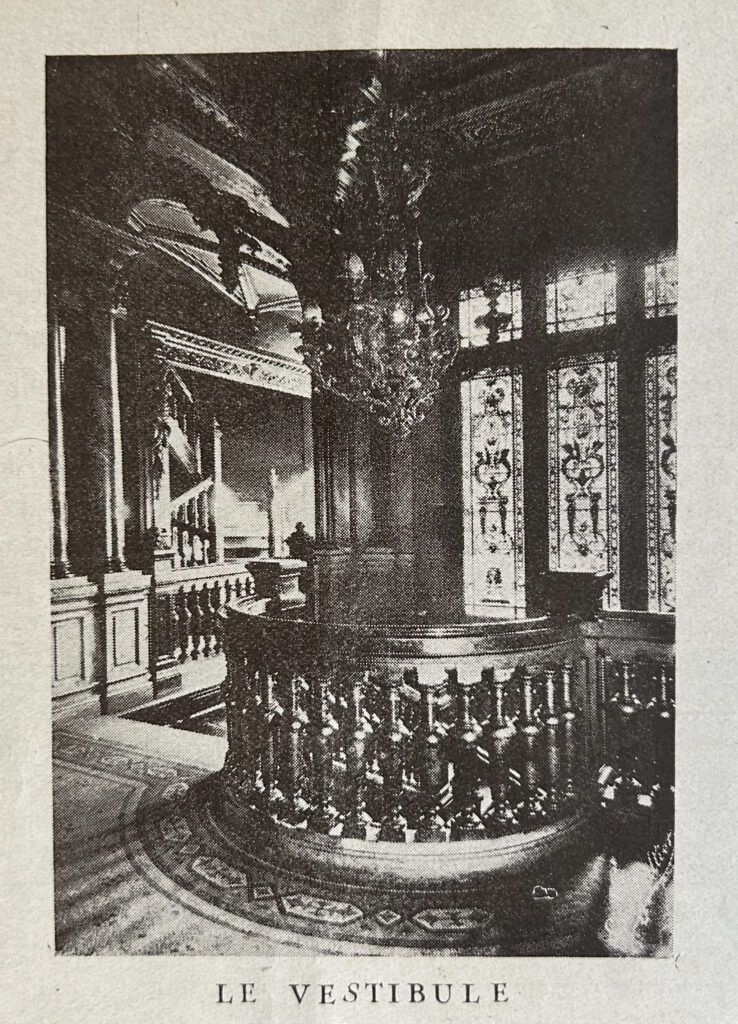
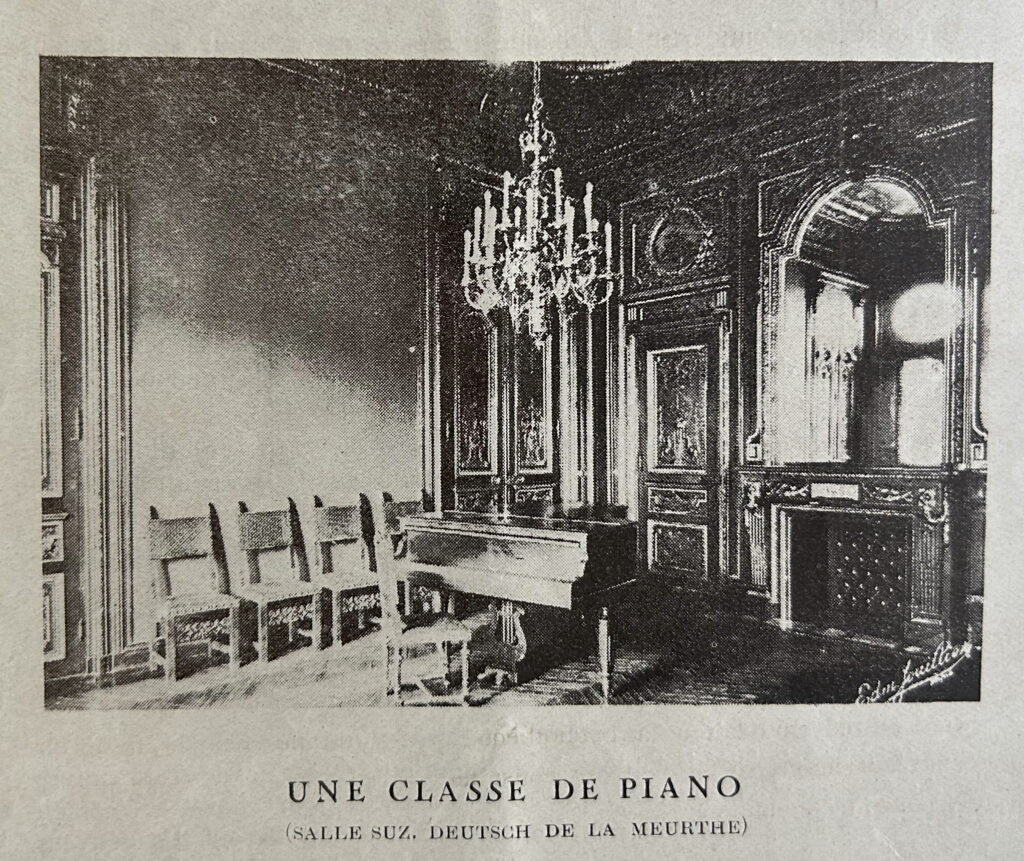
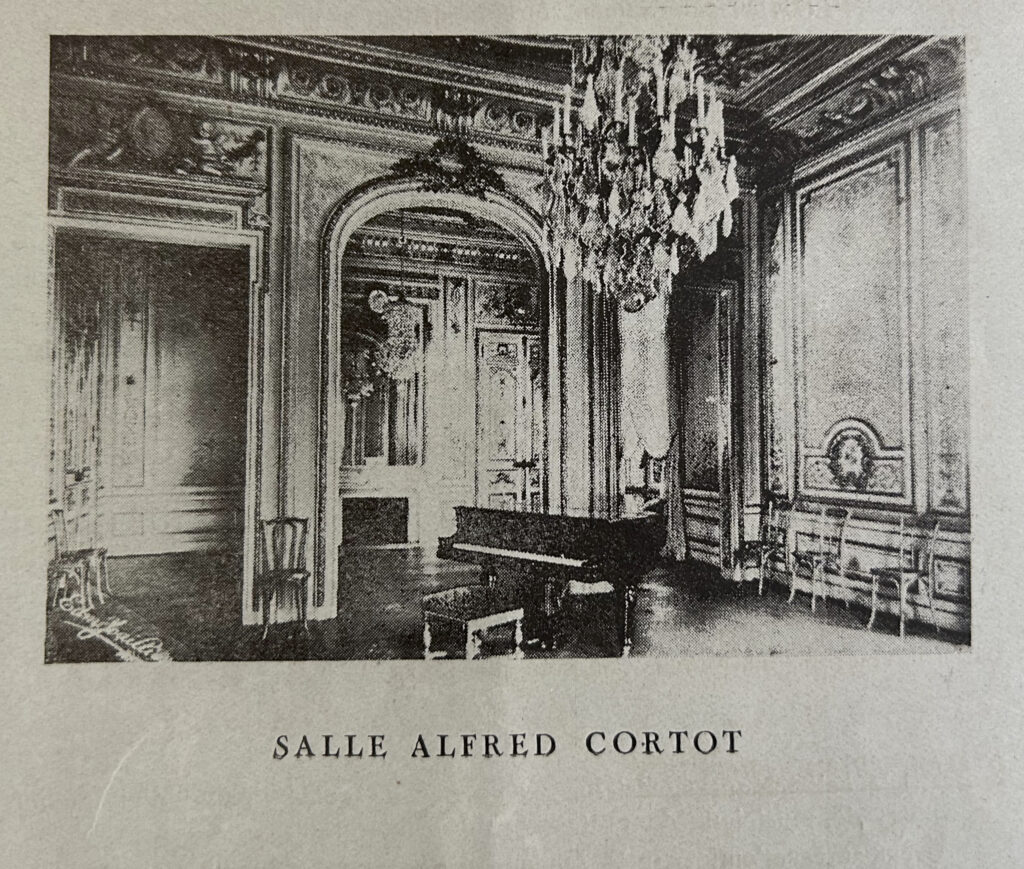
The philosophy of musical education followed by the school emphasized general musical instruction in the study of solfège, harmony, musical form and analysis, and music history, giving students a complete musical foundation for their study of technique. With this background, students followed programs in piano, strings, woodwinds, voice, composition, or conducting, and music teaching. There were examinations every year in July, and at least two recitals during the year, and reports were sent out twice a year. Besides many hours of practicing, and all the lessons and classes, attendance was required at concerts and recitals of teachers and composers. Students were also encouraged to visit museums and other cultural institutions in Paris.
There were three levels of study: preparatory up to age 15, secondary for 2 more years, and superior for 3 more years. The preparatory level finished with a “Brevet” (certificate), the secondary level with a Diplôme d’Enseignement (teaching) and a Diplôme d’Exécution (performance). Similarly the superior level finished with the License d’Enseignement and the License de Concert. It is interesting that the teaching diploma or license was required before the performance diploma or license, in line with the school’s mission to turn out qualified teachers as well as professional musicians.
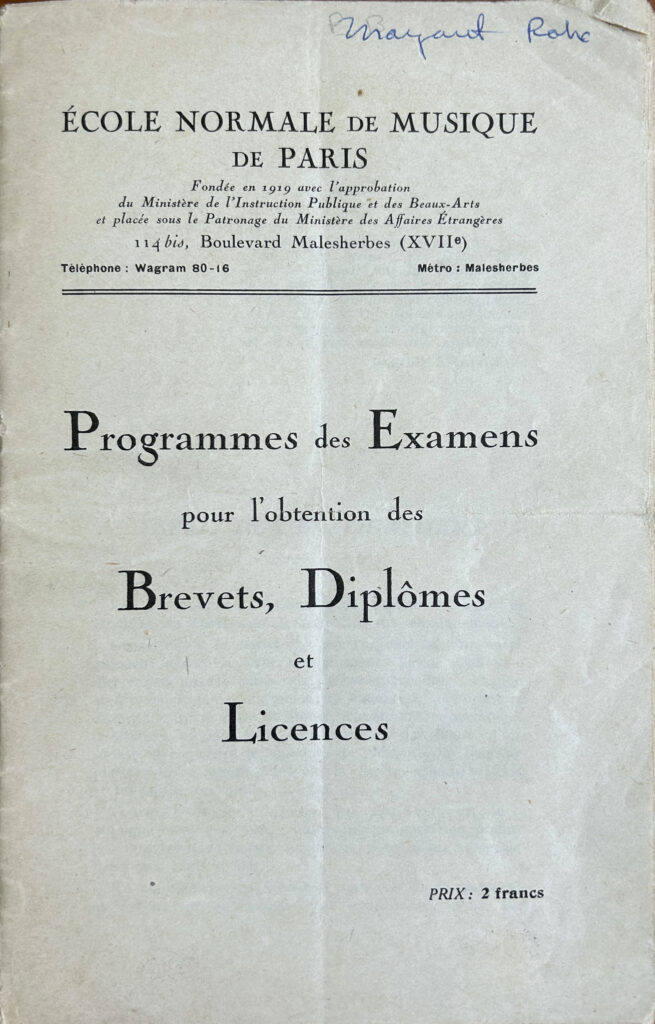
Along with the brochure, was another interesting pamphlet on the requirements for the different levels of study. This began with a brief “Esprit de l’Enseignement”, explaining the school’s philosophy of complete musical training, starting with a quote from Anatole France:
“L’art d’enseigner n’est que l’art d’éveiller la curiosité des jeunes âmes pour la satisfaire ensuite et la curiosité n’est vive et saine que dans les esprits heureux…” (”The art of teaching is only the art of awakening the curiosity of young souls to satisfy later and curiosity is only alive and healthy in happy spirits…”)
The intro goes on to say “si vous voulez etre un musicien, il faut la connaitre dans toutes ses parties, pour mieux se spécialiser dans l’une d’elles.” (”If you want to become a musician, it is necessary to know all its parts, to better specialize in one of them.”)
Following these considerations, “Jouer une oeuvre, c’est la mettre en soi et la communiquer a ceux qui vous écoutent.” (To play a piece is to have it within oneself and communicate that to those who listen.”) To accomplish this, a student should study the title and the text that inspired the piece, the composer and the times, and then to mentally hear how it should sound (”l’audition mentale”) using solfège, and harmonic analysis, and also to study the theme and development, etc. When the student knew the work well enough to the point of hearing it within and even being able to transcribe it from memory (!), then they would be ready to proceed to learn it on their instrument with their teacher.
The pamphlet goes on to list the requirements for the exams at the various levels. Standards were very high and students were graded rigorously. For the License d’Enseignement, a student had to play from memory 6 pieces of various styles, and a piece assigned a month previously. They also were to prepare a lesson to give to a student and demonstrate a knowledge of piano repertoire. They were expected to show proficiency in transposition and harmony, and to sight read an ensemble piece. Finally they were to submit a written thesis on a topic of music history, as well as to make up a lesson on a question chosen a half hour in advance!
For the License de Concert, a student had to play from memory 8 advanced pieces of various styles and genres, along with one modern piece assigned only a month previous to the exam. These were to be accompanied by written reports analyzing each piece and its historical significance. Performance accompanying a sonata for another instrument or participation in a trio or quartet was also required. And finally, the student had to analyze a text assigned an hour in advance for form and harmony and write from memory a fragment of one of the pieces performed.
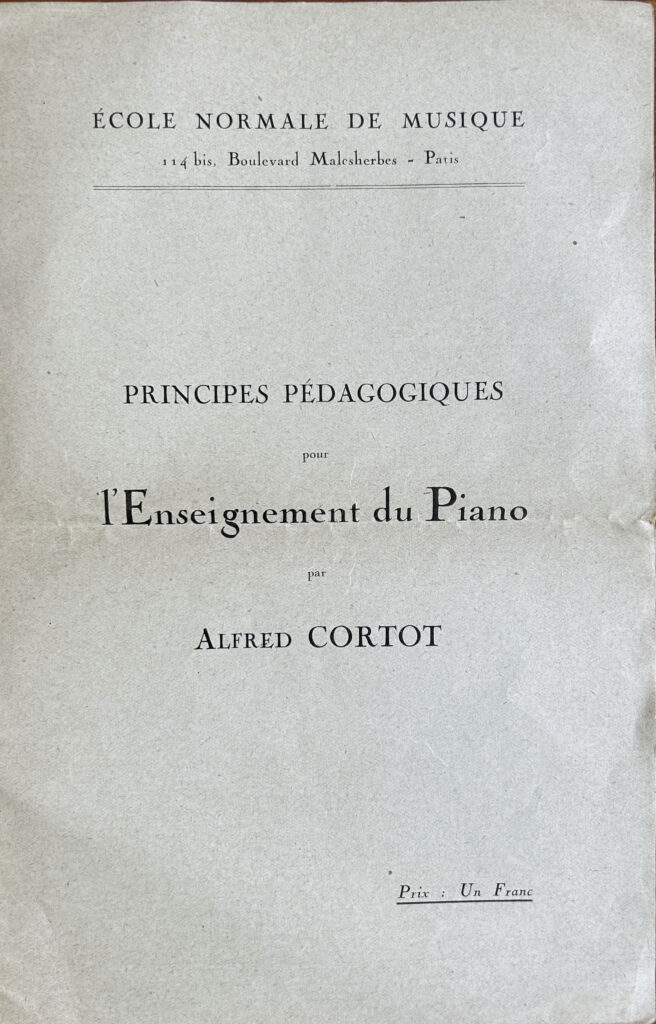
Another interesting pamphlet I found was Alfred Cortôt’s “Principes Pedgogiques pur l”Enseignement du Piano”. In it, he laid out a complete program for a teacher to use: how to diagnose a student’s strengths and weaknesses, how to give a lesson, and how a student should practice.
Cortôt wrote: “Il n’y a pas de mérite à developper le talent d’un élève bien doué, mais il y a une joie infinite à sentir s’éveiller dans une nature récalcitrante le gôut de la musique et l’intelligence de l’éxecution”. (”There is no merit in developing the talent of a gifted student, but there is infinite joy in seeing the awakening in a recalcitrant nature the joy of music and intelligence in performance”.)
And: “Donnez toujours à l’élève l’impression que sa leçon est avant tout une préparation artistique caractère intellectual et que le travail technique n’en est que le corollaire indispensable.” (“Always give the student the impression that their lesson is above all an artistic and intellectual preparation and that work on technique is only an indispensable corollary.”)
From the advice he gave, which emphasized creating a rapport between student and teacher, it is clear that Cortôt was a gifted teacher as well as an outstanding pianist of his day. Mom held him in high regard, having studied under his personal supervision during her last years at the École Normale. It was his recommendation that she continue her studies at the Paris Conservatory, which were unfortunately cut short by the war. Among her memorabilia, I found Cortôt’s annotated edition of Chopin’s Preludes (given to an appreciative pianist friend) and my parents’ record collection contained all of his recordings. His version of the Preludes, even with its recording imperfections has always been my favorite!
Among the memorabilia, were all of the certificates Mom received for the various levels, all signed by Corôt with “mention bien”. I found all of the semester reports in which students were given numerical grades on all of their classes. It seems to me that standards were high and the grading was rigorous. The comments from teachers were interesting. They recognized from an early age that she was gifted (“très doué” and “très musicienne”) but also encouraged her to work carefully and exhorted her to persevere with energy and courage. They praised her progress and hard work, noting she was serious and intelligent. One teacher praised her lively and colorful playing. Another noted she needed more work on technique. But all of her teachers seemed to think that she had good prospects for a career in music. I like to think they would have been pleased to know how her musical education was so important for her whole life.
Here is a summary of her musical studies which she wrote for the Longy catalog.