[Written by Rachel for an economics course at USM. She interviewed her grandfather and found out a lot about his life from the perspective of his career at GE.]
My grandfather, Erwin Carl Rohde, was born in Saginaw, Michigan, in 1916 to German Lutheran parents of the labor aristocracy. His modest upbringing promoted a strong work ethic which enabled him to accomplish his goals of attending college and pursuing a meaningful career. In addition to providing a successful living for his family, he achieved personal success in a career which afforded him intrinsic satisfaction and self-worth. These rewards are ample explanation for his devotion and hard work.
His father, my great-grandfather, Erwin Frederick Rohde, was the youngest of five children of German immigrants in Saginaw, Michigan. Unlike the oldest son who attended the University of Michigan, Erwin was not encouraged to attend college. It was still a common tradition for families to bestow the offerings and opportunities on the eldest son, so, being the youngest, Erwin had to fend for himself after graduating from high school. He survived by doing odd jobs and soon married Elsa Trump.
Elsa was one of four sisters raised in Richville, Michigan, a small farming village of mostly recent immigrants. She completed the eighth grade and worked as a domestic servant until she married Erwin. This was typically the only work done by women outside the home and usually only while they were single. My grandfather recalled a common German phrase, “Kindern, kochen, und kirche” which epitomized the expected roles of married women in that era: children, cooking, and church. Elsa devoted herself to these pursuits while Erwin took a correspondence course in accounting.
According to my grandfather, correspondence courses were quite reputable at this time and, as a result, his father soon landed a job at General Motors. It was a decent job and things went quite well until the Great Depression. Erwin lost his job when the General Motors plant closed and there was little work to be found. These were very difficult times for the family. Erwin became an alcoholic and suffered from other health problems. He never fully bounced back from the effects of the Depression and survived the rest of his life dong odd jobs.
My grandfather held several odd jobs while growing up, including delivering newspapers and washing dishes. He was encouraged to attend college after high school and prepared with the appropriate high school curriculum. In light of the Great Depression, parents saw college educations for their children as an outlet to success and better living conditions. Accordingly, my great grandparents encouraged each of their three children to continue their educations. Money was tight, however, and my grandfather worked for a year before attending the University of Michigan. Tuition was $60 per semester and he had to continue working odd jobs throughout his years in college to afford this. He lived in boarding houses and worked in restaurants for the first couple of years and then had the opportunity to work as a student assistant for two professors, grading tests and papers among other things. This was an arrangement made possible by the New Deal, where some funds were made available for student work on campus. He spoke highly of this experience and felt that it was a positive addition to his education. He graduated with honors in 1939 with a degree in mechanical engineering.
Upon graduating, my grandfather interviewed for many jobs which were had to come by because of the Depression. However, his excellent academic record (a 3.8 GPA) made him an excellent candidate and he was offered a job with General Electric in Schenectady, New York, in September, 1939. He entered a training program which lasted one or two years and then received a continuing offer from GE with a work assignment in the GE plant in Lynn, Massachusetts. He accepted this offer and moved to Lynn where he spent the entirety of his 40 year career with GE. Upon moving to Massachusetts, he met Margaret Brown and married her in 1942.
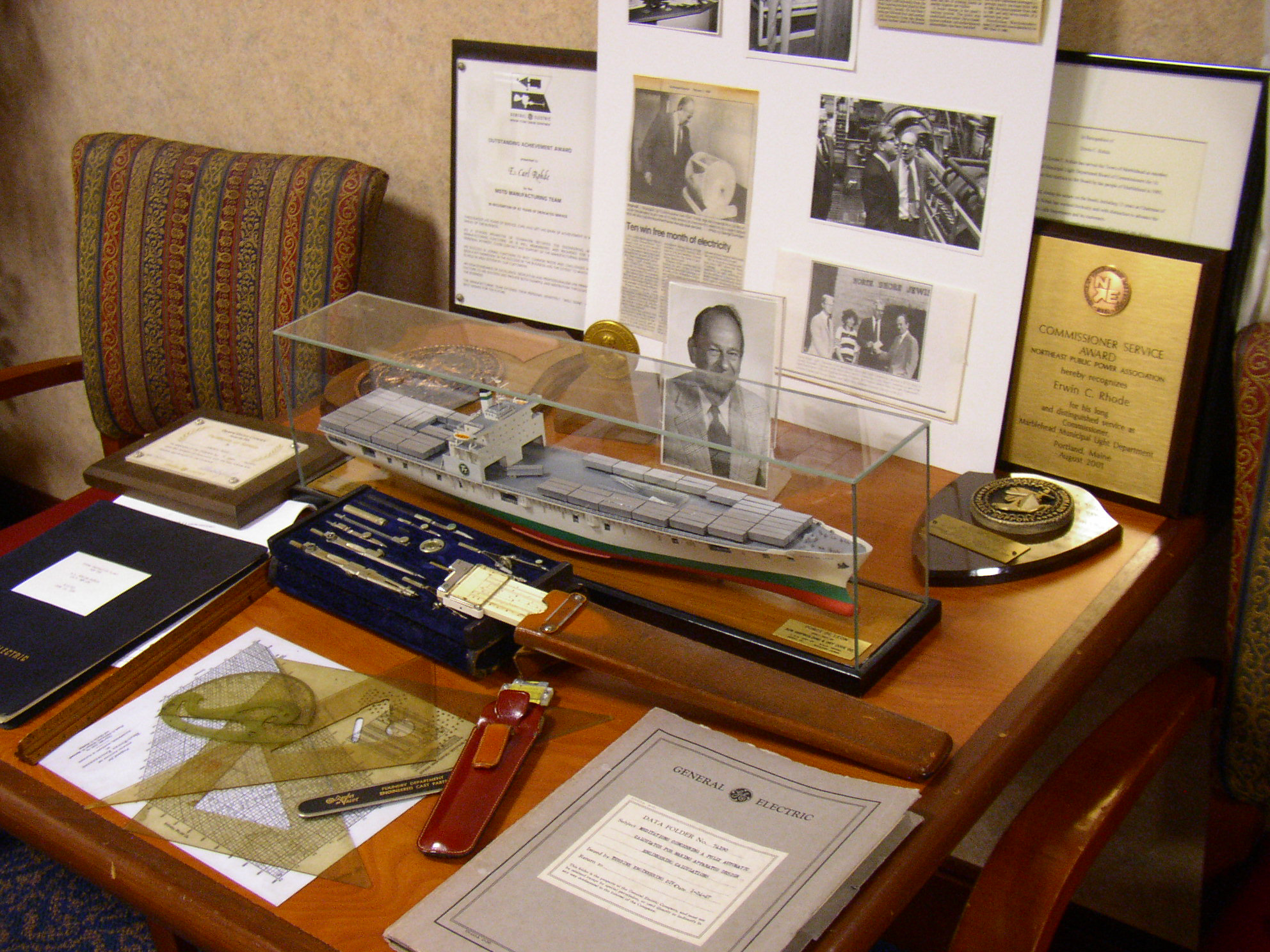
My grandfather’s engineering originally focused on power generation, especially turbines and generators for electricity. This was an area of interest for him because of the rapid growth of electricity at that time and its vast improvements to standards of living. He enjoyed being involved in such positive developments which affected so many people. This focus soon changed with the onset of World War II as efforts turned towards the military and especially to ship propulsion equipment. His employment in this field, of course, exempted him from military service. He was glad, however, to be a contributor to the national war effort through his work at GE. After the war, the focus turned back towards electric power generation and also to merchant ship propulsion. In later years, he was very involved in GE’s contribution to building nuclear powered ships, such as the Navy’s nuclear submarine program. He was proud to be a part of such significant ground-breaking efforts on the national front.
While remaining focused on these themes, he moved from engineering into management. This position required frequent travel, especially to Washington, DC, but also occasionally to Europe and Japan. He was proud of the contributions he was able to make within the company in this capacity, such as advocating for the employment of women and serving as a mentor to younger employees. Likewise, he was proud of the contributions GE was making to country and society. This sense of accomplishment and involvement in positive developments was a key part of his career.
My grandfather has many recollections of labor activity throughout the course of his education and career. He was at the heart of a labor hotspot while at the University of Michigan at Ann Arbor because of its close proximity to Flint, Michigan. He specifically recalled the “sit down strikes” where employees of large auto plants such as General Motors actually sat down in the factories and challenged their employers. This provoked much activism on campus with respect to labor issues. Although he was not involved in this activity, he was surrounded by controversy.
Labor movements played a role at GE, as well. My grandfather estimated that there were four or five major strikes during his career. The United Electrical Workers, in fact, originated in Lynn at the plant where he worked. This union was the subject of nationwide publicity because of presumed communism within the organization. Its reputation was widespread and caused much unrest at GE. As a result, eventually this union was evicted from the CIO and the International Union of Electrical Workers was created in its place. Workers sympathetic to the old union were then a constant source of tension for the new union and there was constant sparring between the two factions. My grandfather recalls that the IUE has always been difficult to deal with, and even to this day, they routinely reject most new contracts.
The unionization efforts never included the technical, professional, or management groups at GE so my grandfather was never an active part of any labor movements. He recalls that there were occasions when engineers debated whether to organize, but it never happened. This was especially debated after the war but aside from some fare-ups of activity, the issue faded. For the most part, engineers seemed to share the sentiments of my grandfather- that the rigid structure of unions would be too constraining for the individuality of their occupation. The general consensus was that their needs would be better taken care of without union contracts. In fact, over the last 20 years or so, the subject has almost disappeared.
My grandfather felt that he was treated very well at GE and he truly enjoyed his work. My mother recalls that he was very absorbed in his job, devoting much of hs time and energy to it. He left at 7:20 every morning and returned home at 5:20 every night, whereupon he could usually be found behind the Boston Globe, catching up on current events. His family was important to him, as well, and he worked hard to provide a good life for his wife and three children. He enjoyed woodworking and built a home in Marblehead, Massachusetts, where he also enjoyed gardening and sailing in his free time.
My grandmother was responsible for most of the domestic duties such as child rearing, cooking, and cleaning. She was also employed a music teacher in Boston once the children were old enough to get by without her. The family structure was typical of the suburban middle class of that era. My grandfather was the primary breadwinner, while my grandmother pursued a musical career mostly for her personal fulfillment. In fact, she often joked that she made so little as a music teacher (in spite of her notable contributions to the Longy School of Music), that she kicked them into a higher tax bracket only to wipe out any extra income she brought in. Nevertheless, my grandfather was very supportive of her career and respected her devotion to it.
My grandfather’s labor history is characterized by one major point. He enjoyed his career. This post distinguishes him from the average worker both of his generation as well as mine. A combination of education, hard work, and wise choices enabled him to be successful. Unfortunately, even a combination of these factors cannot guarantee personal success in a working world focused on consumerism and profit. My grandfather was lucky to find a career in an occupation and workplace which matched his own criteria for success. Every individual must set his or her own criteria to reach reach personal success.