[I have borrowed some of the details in this bio from Rachel’s college essay for an economics class, based on interviewing Dad about his career. I can only wish that I had asked him more about his life while he was still around.]
To see a gallery of photos from Dad’s life, click here.
My father, Erwin Carl Rohde, was born on August 26, 1916 in Bay City, Michigan. I found a corrected birth certificate from 1957, changing the name from “Rhode” to Rohde, a common mistake with our family name! On it, there is no hospital listed, only a residential address, so perhaps he was born at home. When Erwin was 5 or 6, the family moved to Saginaw, possibly to 1915 Phelon St. which is where he grew up and where my grandparents were still living when we visited many years later. Dad was followed by the birth of his sister Betty in 1923, and his brother Bob in 1928.
Dad’s parents were Elsa Anne (Trump) and Erwin Frederick Rohde. Elsa was from Richville, Michigan, a small rural town outside of Saginaw originally called Frankenhilf. Erwin was from Saginaw and Elsa and Erwin married in Saginaw in 1915. I’m curious how they may have met, since Dad recollected they had quite different backgrounds. He felt that his father’s side of the family, being from northern Germany looked down upon his mother’s relatives who had come from more rural southern Germany. Dad also disliked their wedding photo which showed Erwin seated in an ornate chair and Elsa standing by his side.
Dad’s father Erwin was the youngest of 5 children, including a brother, Otto, and 3 sisters. Otto, who was the oldest, was encouraged to attend college and graduated from the University of Michigan. However, as the younger son, Erwin had to fend for himself after high school and did odd jobs. He took a correspondence course and found office work at General Motors but unfortunately he lost his job in the Great Depression. While Dad was growing up, times were very difficult for the family, and many others. Many years later, at a 60th high school reunion which I believe Dad attended, a classmate read a long poem she had written about their classmates. Most of it was humorous, but she included, “We were deep down depression kids, sprung when the market was on the skids…” To help out, Dad delivered newspapers and washed dishes. Kirsten remembers his recollection of a time when a relative in Florida sent them some fresh oranges and what a marvelous treat that was.
Dad attended Trinity Lutheran school through the 8th grade, as did many children from German Lutheran families in those days. He was confirmed in the Lutheran church in 1930 and then went to Saginaw Central Junior High school for 9th grade. He graduated from Saginaw High School with honors in 1934 in a class of 333 students. His Uncle Otto (his father‘s older brother) wrote to him on the occasion of his confirmation and again when he graduated from high school, exhorting him to pay attention to spiritual matters as well as working hard for success. However, Dad did not have a very high opinion of the Lutheran church because he felt it kept women back. “Kindern, kochen, und kirche” (children, kitchen, and church) was the expected domain of women at that time in the German Lutheran community. Kirsten recalls that she heard that Dad was expected by some in the family to become a church minister, but he rebelled against that.
His parents did, however, encourage all of their children to attend college and all three ended up graduating from the University of Michigan: Dad and his younger brother Bob in engineering and their sister Betty in nursing. Dad had to wait a year to raise money for tuition (then only $60 a semester!) and living expenses. He lived in boarding houses and worked in restaurants for the first couple of years, but then later had the opportunity to work as a student assistant for two professors. I remember him saying that a lot of the students in the boarding houses were socialists, but I don’t think he ever joined their cause, although I can’t help thinking it may have contributed to his world view.
At U. Michigan, Dad was an honor student for all 4 four years and in 1938 he was inducted into Tau Beta Pi, a national scholastic engineering fraternity. He also received the Cornelius Donovan scholarship that year. He graduated in 1939 with a B.S. in Mechanical Engineering and a 3.8 GPA. He interviewed for many jobs and was offered a job with General Electric in Schenectady, NY. He completed a training program there and then received a continuing offer from GE at the Lynn, Massachusetts, plant and moved there in 1940.
Sometime after he arrived in Lynn, he met my Mom, Margaret Brown, who had just arrived from war-torn Europe and was living in Nahant. Her family had been evacuated from Paris where she had grown up and where my grandfather worked for the American government. She was a pianist and had been trained in music schools in Paris and was currently attending Radcliffe College. They married in Swampscott on March 28, 1942. Their first home was an apartment on West Baltimore St. in Lynn which cost $11 a week. (I found the original rent receipt!) Along with their few possessions they moved in with Mom’s Pleyel piano which had come with her from Paris. On the back of a photo sent to her parents in Washington DC, Mom wrote, “every bit of it is ours and we owe no man money.” Having their own home after the hardships of the 1930’s they each had lived through meant a lot to both of them.
While Mom finished a year at college and began to teach music classes at the Longy School in Cambridge, Dad continued his work for GE. Because of his work, he was exempt from military service. They soon moved to Swampscott where they kept a victory garden during the war years. At one point, they faced the possibility that Dad might be drafted, but fortunately that never happened. I remember Mom saying once that they had waited to have children until the war ended. I am sure that the war cast a dark shadow over everyone during that time. They visited Mom’s parents and her younger brother Peter in Washington, DC, in 1943 and Dad’s parents and extended family in Saginaw, Michigan, in 1946, stopping at Niagara Falls.
In 1947, they moved to a sunny upstairs apartment with a backyard, at 3 Bowden St. in Marblehead. I was born on September 3rd that year in Salem Hospital. My sister Kirsten soon followed in 1949 and my brother Carl in 1950. I’m told that my first sleeping space was a dresser drawer, but soon I moved to a crib that Dad assembled. He also built a floor loom for Mom around that time, which became a hobby for her for many years, as was woodworking for Dad. Another hobby for him was photography and he set up a home darkroom for developing and printing black and white photos. For many years afterwards the family Christmas card was a photo of the kids with a hand-lettered greeting!
In 1950, they purchased a small undeveloped lot at 25 Flint St., on Marblehead Neck for $6000 which was a lot of money in those days. They hired an architect who designed a “mid-century modern” single floor house with a roof that slanted upward to create a SW-facing 9’ wall of windows looking towards the ocean down the street. I have always thought it interesting that they were attracted to modern style, but I think, to them, it meant leaving behind the past and coming into a new age of relative peace and prosperity and modern ideas. I still have some of their “Danish modern” furniture and a taste for Marimeko fabrics of that era.
From the beginning, Dad threw himself into the building project and helped to work on it himself, occupying many weekends. Sometimes, Mom would accompany him and try to help while managing the children. It was finished enough to move into on January 28, 1952. I found a photo looking out the living room windows of stormy waves rolling in, which Mom sent to her parents. She wrote on the back, “The house is very comfortable and there is no feeling of cold through the windows!” I wonder if that was actually true, since the windows of that time were only single-paned. (It was also hot in the summer sun!) The house was actually only a shell, and there would be a circular saw in the living area for a long time to come while Dad built room dividers and closets in the bedrooms, butcher-block counters and cabinets for the kitchen, and installed mahogany panelling in the living room. Another project was laying vinyl tile throughout the house on top of the chilly concrete slab.
At GE, Dad’s first area of focus was in designing turbines and gears for electric power generation. However, this changed during the war to ship propulsion for military use. After the war ended, his work shifted to merchant ship propulsion and also power generation. He was also interested in designing an early computer to help with making engineering calculations. In later years, he was involved in designing turbines for nuclear powered ships, especially for the Navy’s nuclear submarine program as well as the merchant marine. As Rachel’s essay points out, in all of these areas he felt he was making a positive contribution to the country and personally took a great deal of satisfaction in his work.
As his career unfolded, he moved from engineering into management. I do remember him saying that at times he missed the technical aspects of engineering, but he made good use of his background in overseeing projects, managing contracts with the Navy and other clients, and representing the company overseas. Starting in 1957, with a trip to Norway, he made many trips to Europe, including Norway, Germany, the Netherlands, England, Spain, Italy, Poland, and Japan. On one trip to Germany, he tore a page out of a Hamburg phone book, to show us that Rohde was a common surname there!) He had many long-standing relationships with colleagues both at home and in other countries. He often made trips to Washington DC, to consult with Navy people and had a personal relationship with Admiral Rickover from the nuclear submarine program, who, reportedly, was not always easy to get along with. A standing joke was that they traded neckties, and Dad felt he gave away better ones than he got in return. He was occasionally invited to go on sea trials of new ships that had GE equipment, including once on a submarine, which he said was very claustrophobic!
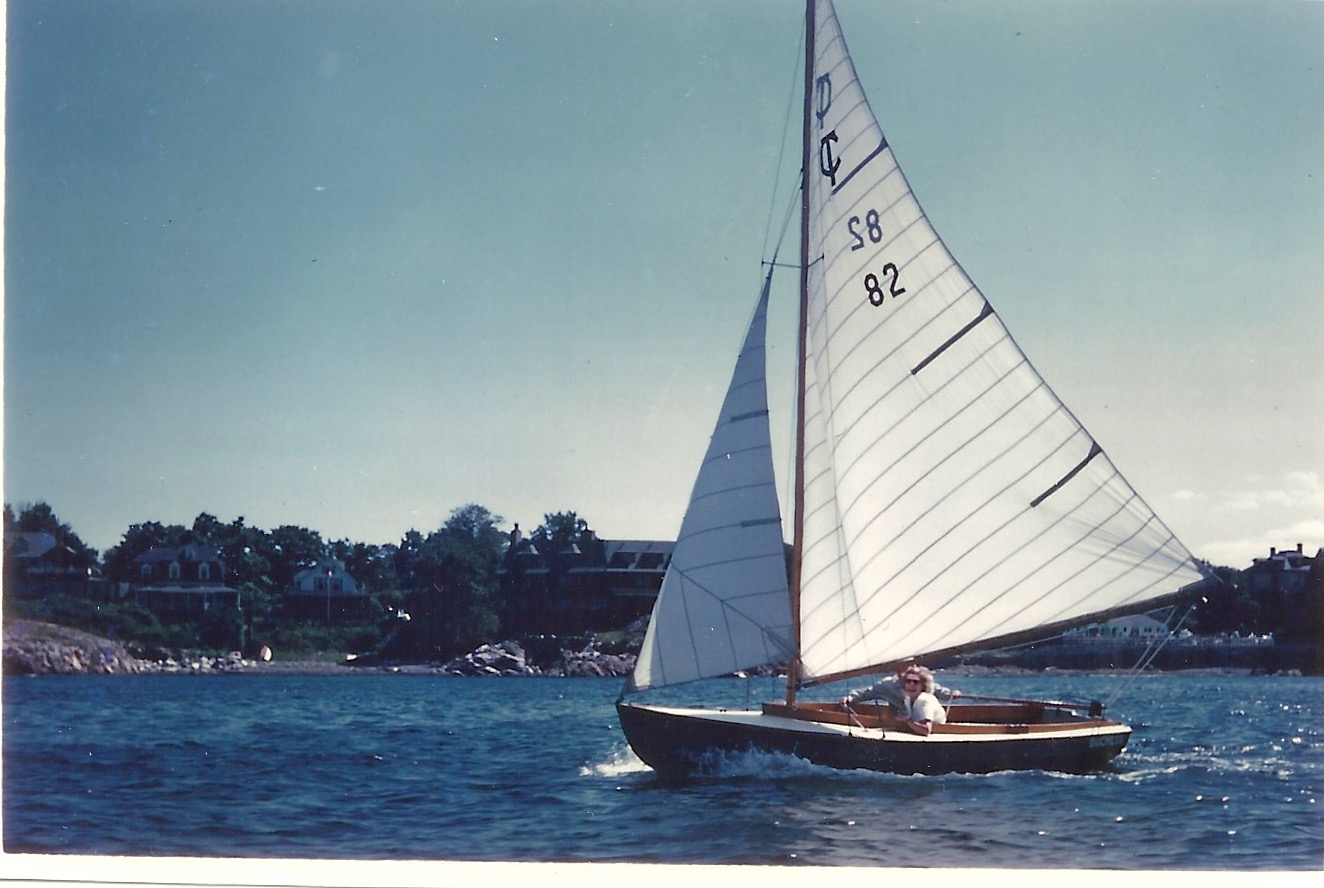
Around 1955, Dad bought the “Duchess”, a 16’ Town Class sloop, from a colleague at work. A photo shows a bemused new skipper contemplating the boat tied up at a dock waiting to set sail. Mom commented on the back, “This boat means so much to Erwin. It is the first real luxury he has permitted himself… I think this is going to do him a world of good!” At that point, sailing became a focal point of our summers, starting on Memorial Day when the boat was launched, until the last race of the year on Columbus Day. The Town Class association was very active with races on Saturday afternoons, Sunday mornings, and a “Twilight” series on Tuesday and Thursday evenings. And then there was the full week of Race Week in July, with enough “Townies” for 2 divisions. Dad quickly became one of the top sailers in the class and one year won the Race Week series with Mom crewing on all the races. Dad joined the Corinthian Yacht Club and also served on the race committee. I remember hanging around the race committee booth at the CYC and studying the charts with all the marks. I occasionally went along to crew, and a favorite memory is that once the whole fleet was becalmed on the far side of Cat Island during a total eclipse of the sun. Years later I asked if he remembered that which he did.
Almost as soon as they were settled in the new house, my parents began to landscape the yard with trees and shrubs. Within a few years there were flowering plants of many kinds, especially crab apples and azaleas. It required a lot of hard work digging in rocky soil and many trips to nurseries to pick out seedlings. I remember that we used to enjoy running around in the rows between the trees for sale. Dad was always a gardener at heart and his vegetable and flower gardens gradually increased in size. He liked to grow tomatoes and his home-made gazpacho became a summer treat.
In the early 1970’s, with Carl’s help, he built a deck around part of the house which became the favorite pace for many al fresco dinners, especially baked stuffed lobster, another of Dad’s specialties. Soon after that he began to work on a greenhouse attached to the back of the house. When finished, it housed Mom’s growing collection of bonsai trees and other exotic plants. In the wintertime, it was filled with flowers, including Dad’s prize-winning cyclamens. Mom always called it “our favorite room.”
Besides these large projects, Dad also kept busy in his downstairs shop from time to time, building desks and vanities for our bedrooms and later on some beautiful furniture. Sometime around 1970, he built a harpsichord for Mom from a kit. That was a very engrossing project, as he did all of the assembling, and finishing, including trips to the MFA’s collection of period instruments to investigate the appropriate decorative details. For the trim, he created his own pattern and silkscreened it himself. And then, typical for Dad, he built an electronic tuner to help with the constant tuning required by a wooden stringed instrument.
Actually, electronics was another hobby, as he built more than one Heathkit stereo system. I was quite interested in that and I remember him explaining how vacuum tubes worked and looking at circuit diagrams. And when it came time for science projects, he did more work on them than we did. Our favorite was a cloud chamber, made out of a large coffee can with black felt in the bottom, sitting on a chunk of dry ice we got from the West Lynn Creamery. Back in those days, you could buy a tiny radioactive sample from Edmund Scientific to use as the source of the vapor trails.
Thinking back on all of Dad’s many projects and hobbies, it’s a wonder how he managed to find time to do so many things, while also being so involved in his job with GE. We remember him leaving at 7:20 am and returning at 5:20 pm and after supper, spending the evening reading the newspaper or a magazine while listening to classical music on the radio. He also watched the Red Sox on TV and sometimes other sports. And sometimes he would set up the slide projector and show slides from his trips which I always enjoyed, along with popcorn Mom made. In the summer, we went sailing and in the winter we went skiing, usually in New Hampshire. Dad and Mom even tried it themselves. For quite a few years, we went to North Conway for a few days between Christmas and New Year’s, and back then, there was usually plenty of snow! Dad was also a fierce ping pong and badminton competitor. But he would only come down to the beach at the foot of the street occasionally when we went swimming.
I think we always knew that, for him, work came first. I remember going in to GE a few times and saw his office once or twice, and visiting the employee’s store for a new radio or some other GE product. Before my parents had 2 cars, there were times when we had to go and pick him up at work and I thought it was interesting to go inside the gate of the large GE factory complex. But, I didn’t really know much about his work and he didn’t talk about it much. Now I cringe when I remember arguing about “the military industrial complex” and having Dad end the argument by saying I had no idea what I was talking about. I suppose he was right, having lived through WWII and the cold war which followed, and I only had slogans picked up from my HS peers without a lot of investigation. We were each, I suppose, a product of our times, and it was the 1960’s back then.
I recall vividly some of the history-making events of those days: being glued to the TV after the assassination of JFK, and hearing about the Cuban missile crisis. Kirsten recalled that a traumatic event occurred in 1963, when a nuclear submarine, the USS Thresher, went down off the coast of Cape Cod with the loss of the entire crew. The sinking was apparently due to structural issues, not the turbines, but Mom said that Dad was very affected by the event although he didn’t speak of it.
After the 3 of us left home for college and beyond, Mom and Dad took several trips together, starting with a trip to England and France in 1971. (Mom had gone by herself in 1968, her first trip back to Paris since she had left France in 1941.) In 1974, they cruised up the coast and the fjords of Norway as far as the North Cape. In 1977, they went on an American Bonsai Society sponsored trip to Japan and toured many bonsai gardens and other sights. In 1978, they went on a history-focused cruise to Greece and the Mediterranean and visited many archeological sites. I enjoyed visiting after these trips and seeing their slides!
Mom and Dad made several trips to Florida when we were living there and they also visited Carl in Boulder, and Kirsten in Seattle. Dad’s Mom, Grandma Rohde, visited Marblehead a few times after Grandpa died, and there were visits from other relatives, too. We visited Mom and Dad in Marblehead as often as we could and I always looked forward to Mom’s cooking and being by the ocean. They always enjoyed time with their grandchildren. I was glad that we lived close enough in Maine so they could visit us there for holidays and graduations!
Dad retired from GE in 1981, after a career that had spanned 43 years. His colleagues held a very fancy retirement party for him and created a slide show of the many aspects of his GE career. In a large 3-ring binder which I still have, there were many letters of appreciation and friendship, including people he had worked with from overseas. He was also awarded the David W. Taylor Medal “for notable achievement in marine engineering” by the American Society of Naval Architects and Marine Engineers. At GE, the Medium Steam Turbine Department Product Development Lab was named in his honor “dedicated to the pursuit of excellence inspired by his technical leadership”.
Here is the slide show his colleagues at GE created and showed at his retirement party, with a lot of glimpses of his career and the ships he worked on. Here is the citation from the Taylor Medal presentation, which gives a synopsis of his career.
Dad’s friends at GE also presented him with one of the first personal computers then available: a TRS-80, with 5 1/4” floppy drives. Dad became quite interested in BASIC programming and using it to help Mom with her genealogy research. He upgraded a couple of times over the years and always recycled the old models to us which we found fascinating. I couldn’t believe how much of an improvement word processing was, and the kids loved the simple games that were available then!
In his retirement, Dad continued to tend his vegetable gardens and the apple and other fruit trees he had planted and to spend time on the computer. He also kept in touch with his former colleagues and was elected to join the “Living Legends of Lynn” and attended their monthly luncheons. He was also busy, as he had been elected to be the Light Commissioner for the town of Marblehead and served in that position for 15 years. Based on his experience, he was well suited to be the town’s representative in negotiations with the New England power grid and overseeing the town’s electric power utility. It gave him a lot of satisfaction to see to completion a project moving underground the tangle of overhead wires along Washington St. in the old part of town. I was amused to find a photo of an electric truck the Town purchased and he drove over to show Mom.
A meaningful trip to Michigan took place in 1994, when Dad and Mom went to a family reunion with Dad’s sister Betty and brother Bob and other family members. While they were there, they visited cemeteries in Richville and Saginaw and found the graves of some of the family ancestors. I remember Mom was quite excited to find some of “Erwin’s people” as she called his relatives and to add them to the family tree.
After a tragic illness, we all were very sad when Mom passed away in 1995. Dad had worn himself out taking care of her, and I know he missed her terribly. I travelled with him to Colorado to Carl’s for Christmas that year and for his 80th birthday the following summer. Afterwards, we visited Marblehead as often as possible. For some years, Dad would drive up to Maine for holidays and I was glad he could attend Rachel and Keith’s wedding in 1998 and her graduation in 2000. That year, Kirsten, Carl with his wife Kathy, and I took him on cruise around Glacier Bay, in Alaska. The highlight of the trip was Dad joining me in a double kayak to paddle around with the ice floes.
Later that year, Dad surprised me on a visit to Marblehead by telling me that he had decided to sell the house and move to Brooksby Village in Peabody, a new retirement community then under construction. Some of his colleagues from GE had also moved there and I was glad that he would be near people he knew. He hired a wonderful 2-woman team called “Facilitations” to help with sorting through all the stuff in the house, including all of Mom’s genealogy research. He also decided to donate the harpsichord to UMF, where I was working. Later, he attended a concert with the UMF orchestra featuring the newly restored harpsichord. He also donated Mom’s Pleyel piano and a collection of string instruments built by her father to the Longy School.
He put the house on the market and moved to Brooksby in 2001. Not surprisingly, it sold immediately because of the prime location, only to be quickly torn down and replaced by something much larger, which we expected. It seemed very sad to Kirsten and me as we left the old house with Dad carefully turning off the water as we escorted him to his new apartment. So many memories! But Dad seemed very content for the next 3 years. He took daily walks up the hill to the apple orchard behind Brooksby Village and enjoyed Friday mornings with the current events club and occasional visits with his friends. We visited often and especially enjoyed the dining room menu and the lavish holiday offerings. Dad always seemed very happy to see family, and especially his new great grand-daughter Shannon!
Dad passed away on September 19, 2004 soon after celebrating his 88th birthday. Kirsten was with him when he died and Sarah and I were also nearby. The rest of the family soon assembled and Brooksby helped us to organize a memorial gathering for him. Sarah put together several displays of photos and we gathered some meaningful pictures and other memorabilia to display A few days after that, we held a graveside commemoration at Waterside Cemetery in Marblehead. At both events, many colleagues, friends, and others came to remember Dad and share their stories.
At his graveside memorial ceremony, several of his colleagues recalled fond memories of Dad. (At work, he was always called “Carl”.) We were amazed by some of the amusing stories they told. When we were growing up, Dad never talked much about his work; while he was proud of the work GE did, he was not one to take personal credit. I think he was a valuable team player as well as a talented engineer. One colleague recalled that whenever a problem arose with a client, that Dad was often the person who was sent to straighten things out.
Another aspect of his work which I hadn’t appreciated until then was that he was able to mentor younger engineers and tried to advocate for women and minorities in the field. One woman attended his memorial and spoke of how he had recommended her in applying for a management position which she would not have considered without his encouragement. In his will, Dad left a large bequest to the University of Michigan to establish a scholarship fund for women in science and engineering. He also left generous provisions for his great-grandchildren’s college educations.
Here is the letter that we sent to the University of Michigan concerning the gift.
A few photos from the Brooksby celebration and the Marblehead gathering can be viewed here.
Here is Dad’s obituary
Here are all the photos I have collected from family albums, and other sources about my Dad’s life.