Among Mom’s geneology materials, I found a wonderful book on the history of Frankenhilf, Michigan, now known as Richville. This spiral bound book was put together in 1976 to celebrate the 125th anniversary of the founding of St. Michael’s Lutheran Church by the first settlers of the town. Among them were Leonard Trump and Michael Englehardt and their families, my great-great grand parents. The book is full of old photos and history about the town (as well as the church) and I have found it fascinating to imagine what the lives of those people could have been like. I think this book was given to Mom by Dad’s sister Betty.
Some photos from the book, can be viewed here.
Frankenhilf was the fourth of the settlements in the Saginaw Valley area of Michigan founded by German Lutheran immigrants from the southern German area of Bavaria. These four communities were intended to assist poor Lutherans from the rural Franconia region to own land and establish communities that were free from some of the difficulties they faced in Germany. These included poor crops, oppressive military service, the threat of religious intolerance, and the state’s requirement that they own property of a certain value before being allowed to marry.
With funds from a “Colonization Capital Fund”, raised in Germany, Frankenmuth was founded 1845, Frankentrost in 1846, and Frankenlust after that. In addition to providing inexpensive land for new settlers, it was hoped that the colonies with their pastors would unite other settlers in isolated places and also to serve as missionaries to the indigenous people, who unfortunately in those days, were viewed as heathens. However, not much is said about that endeavor and the Frankenhilf settlement did not include it in its mission. The plan was that settlers would be given land and there would be some light industries to enable them to pay off their land and their passage from Europe.
In 1849, 1592.73 acres of land was purchased from the state of Michigan at a cost of $1.25 an acre, totaling $1990.91. Although a large group of immigrants from Bavaria set out in 1850, most of them joined other settlements after arriving in America, leaving only 2 families and their pastor as the first settlers of Frankenhilf. However, within a few more years others followed, including my ancestors, and the community grew slowly.
Their journey was arduous. After crossing the Atlantic and arriving in New York, typically, they took a steamer to Albany, a train to Buffalo, a boat to Detroit, and a train to Saginaw. From there, they travelled on foot or boat or with oxen to reach Frankenhilf.
The location of the town was along a river and it eventually became a rich farming region, but in the beginning it was heavily forested with many swampy areas. Settlers built log cabins and struggled to clear land and build primitive roads. The nearest other settlement was Frankenmuth, 8 miles away, and it was hardly any better off when provisions were needed. Many of the early settlers were originally from small towns and unprepared for frontier life. But they were a tight-knit community and survived by depending on each other.
The first St. Michael’s Church was a log building, erected in 1853. Unfortunately soon afterwards, the pastor left for Iowa on account of a schism within the Lutheran church. Apparently the issue was that some felt that local congregations should be autonomous rather than under the control of higher church authorities in Germany. (Perhaps a more democratic new world approach?) Leonard Trump had also made plans to leave with the pastor and had sold his land. However, the buyer was unable to raise the money from Germany and he stays behind. Later, it was reported that he ended up being grateful for that.
It took a few years for the community to sort this out and find a permanent new pastor. A new frame church was built and dedicated in 1875. George Trump (Leonard’s son and Paul Trump’s older brother) was on the building committee. This church served the community until 1971 when a new building on the same site was dedicated.
In 1862, the post office ordered that the name of Frankenhilf be changed to Richville, to avoid confusion with the other Franken communities. Eventually the community adopted that name. The railroad came through in 1873, and Frankenhilf, now Richville, was no longer isolated.
The book has many photos of early farms in the area, showing the frame houses and large barns that were built. The farms raised sugar beets and other crops and grew grain for their cattle. Neighbors helped each other with barn-raising and harvesting. One photo from 1908 shows John George Trump (Leonard Trump’s son and Paul Trump’s older brother) with his grand-daughter looking at a plow he invented. Another photo of a farm wife with 3 children in front of a house and large barn in 1900 gave me an opportunity to do some genealogical research!
Besides the church, the community built several schools. These were parochial schools that taught both religious subjects in German and secular subjects in English. From the many photos of church and community bands, it seems that music was also important. Various Trumps and Englehardts show up in some of these and in other photos in the book.
World War I was a difficult time for German communities. Because they kept to themselves and were loyal to their old traditions, and many still spoke German, they aroused suspicion and hatred. In 1918, German aliens were ordered to register and listed in newspaper as “enemy aliens”. The Ku Klux Klan targeted Germans and the US government banned the use of the German language. German language newspapers were forced to close, or switch to English or merge with other English language papers. A referendum to close the parochial schools was narrowly defeated. In spite of the harrassment, the Frankenhilf book lists 23 local residents who served in the armed forces. In 1920, Prohibition was adopted which threatened the German beer-drinking culture (which continued underground!)
After the war, Richville became more connected to the rest of the world with electricity and radios, better roads and the automobile. Young people moved beyond Richville and new residents came from other places. The parochial schools moved to instruction in English and the church offered English services in addition to German. (A weekly German service was still held in 1976, when the Frankenhilf book was printed.) My grandmother and her sisters all married and moved to other places nearby but there were still ties to their past. When we visited Saginaw in the 1950’s there was always a big outdoor picnic in a nearby park with many relatives and German food of all kinds.
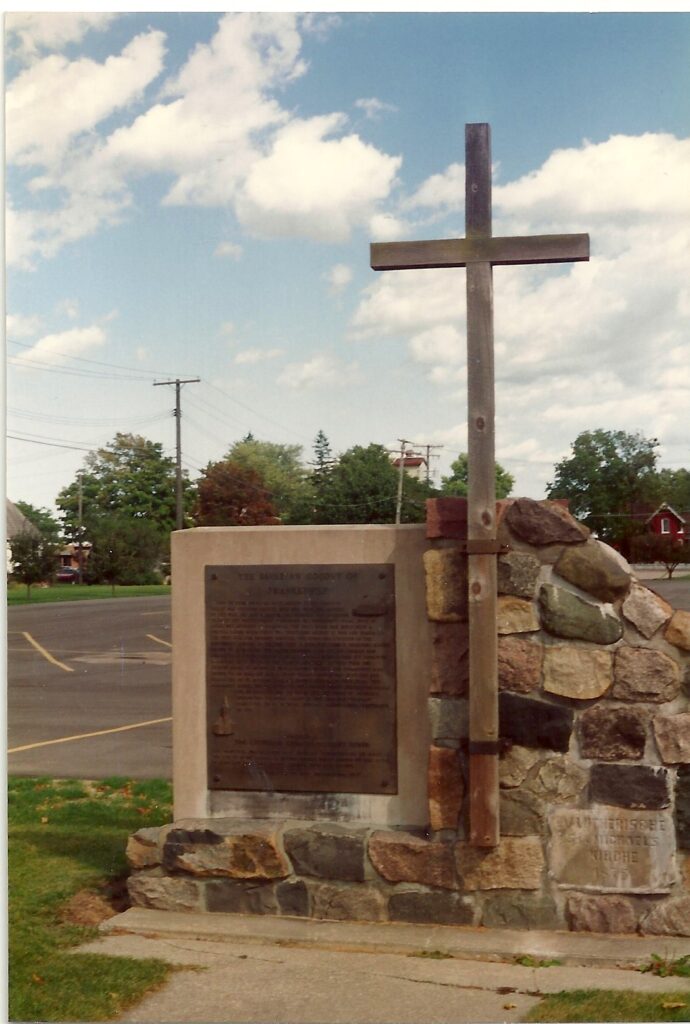
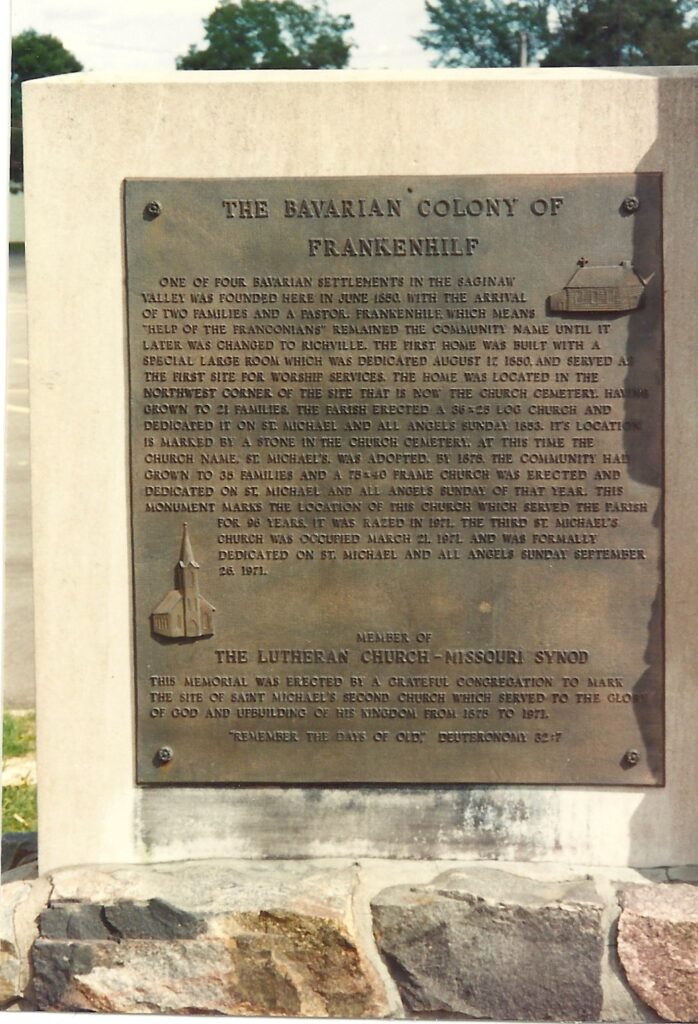
To read the text, go to the Frankenhilf Monument.